
Republicans want to game the next election. Could Democrats get ‘ruthless’ to respond?
Entities mentioned:
- Republicans: Power, Control, Competitive spirit
- Democrats: Power, Justice, Competitive spirit
- Donald Trump: Power, Control, Ambition
- Ron DeSantis: Ambition, Power, Competitive spirit
- Mike Johnson: Power, Control, Loyalty
- Beto O'Rourke: Ambition, Power, Determination
- Gavin Newsom: Power, Competitive spirit, Ambition
- Hakeem Jeffries: Power, Competitive spirit, Justice
Article Assessment:
Credibility Score: 75/100
Bias Rating: 45/100 (Center)
Sentiment Score: 35/100
Authoritarianism Risk: 65/100 (Authoritarian Tendencies)
Bias Analysis:
The article presents views from both Republican and Democratic perspectives, providing a relatively balanced account. However, there's a slight lean towards criticizing Republican actions more heavily, while presenting Democratic responses as reactive.
Key metric: Electoral Integrity
As a social scientist, I analyze that this article highlights a significant threat to electoral integrity in the United States. The attempts by Republicans to redraw congressional districts mid-decade, and the potential Democratic response, could severely undermine the fairness and representativeness of the electoral system. This practice of partisan gerrymandering, if implemented, would likely lead to increased political polarization, reduced competitiveness in elections, and a disconnect between the popular vote and seat allocation. The potential abandonment of nonpartisan redistricting commissions in Democratic-controlled states like California could further erode public trust in the electoral process. This situation reflects a dangerous escalation in partisan tactics that prioritize short-term political gain over long-term democratic stability. The article also underscores the importance of nationwide standards for redistricting to ensure fair representation and maintain the integrity of the electoral system.
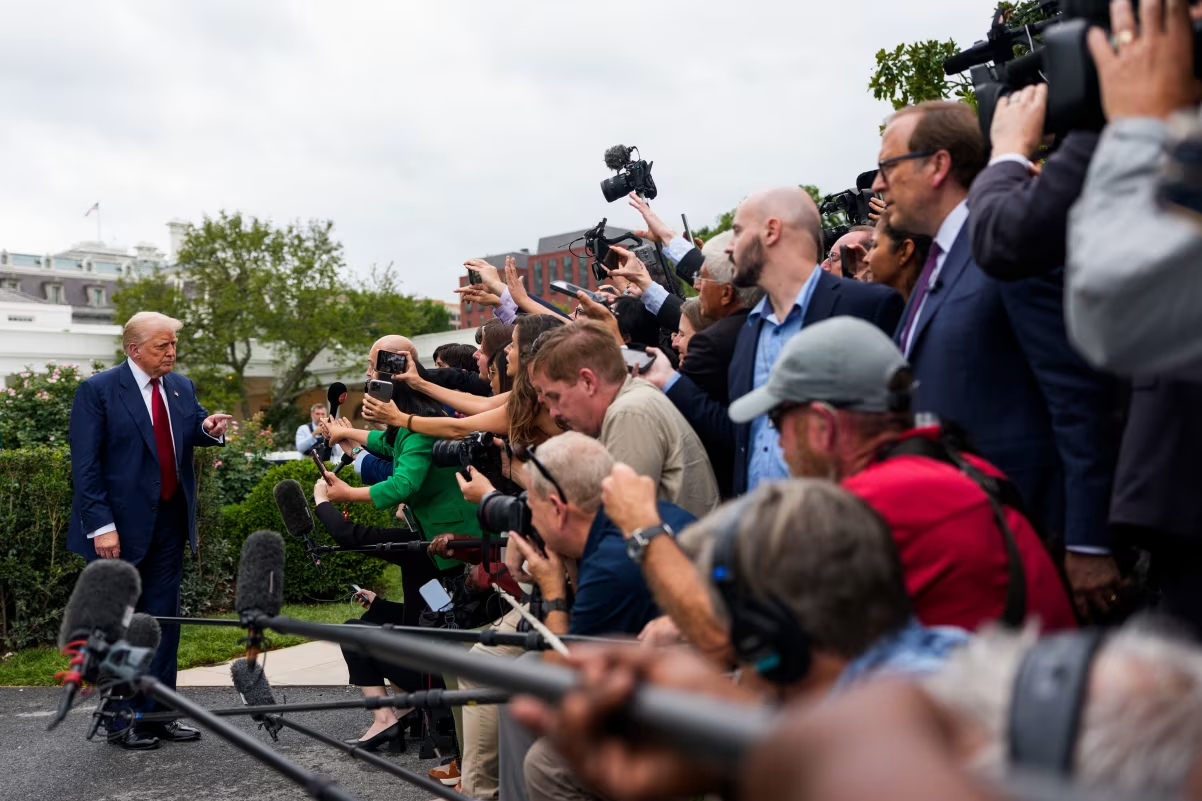
Trump’s rewriting of reality on jobs numbers is chilling, but it could backfire
Entities mentioned:
- Donald Trump: Power, Control, Self-preservation
- Erika McEntarfer: Professional pride, Duty, Integrity
- Bureau of Labor Statistics: Duty, Professional pride, Integrity
- Federal Reserve: Independence, Duty, Professional pride
- Kevin Hassett: Loyalty, Duty, Self-preservation
- Chuck Schumer: Opposition, Indignation, Duty
- Jamieson Greer: Loyalty, Duty, Self-preservation
- William Beach: Professional pride, Integrity, Concern
Article Assessment:
Credibility Score: 75/100
Bias Rating: 30/100 (Lean Left)
Sentiment Score: 25/100
Authoritarianism Risk: 70/100 (Authoritarian Tendencies)
Bias Analysis:
The article leans left in its framing, presenting a critical view of Trump's actions and their implications. While it cites various sources, the overall tone and language choice suggest a negative stance towards the administration.
Key metric: Economic Stability and Credibility
As a social scientist, I analyze that this article highlights a significant threat to the integrity and independence of key economic institutions in the United States. The firing of the Bureau of Labor Statistics Commissioner and attempts to influence the Federal Reserve indicate a trend towards politicizing economic data and policy. This could have severe consequences for the U.S. economy's reputation and stability. The article suggests that Trump's actions may erode investor and business confidence, potentially leading to economic uncertainty and instability. The comparison to countries like Argentina, Greece, and China underscores the risks of manipulating economic data for political gain. The broader implications of these actions point to a weakening of democratic norms and an increase in authoritarian tendencies, which could have long-lasting effects on U.S. governance and economic policy.