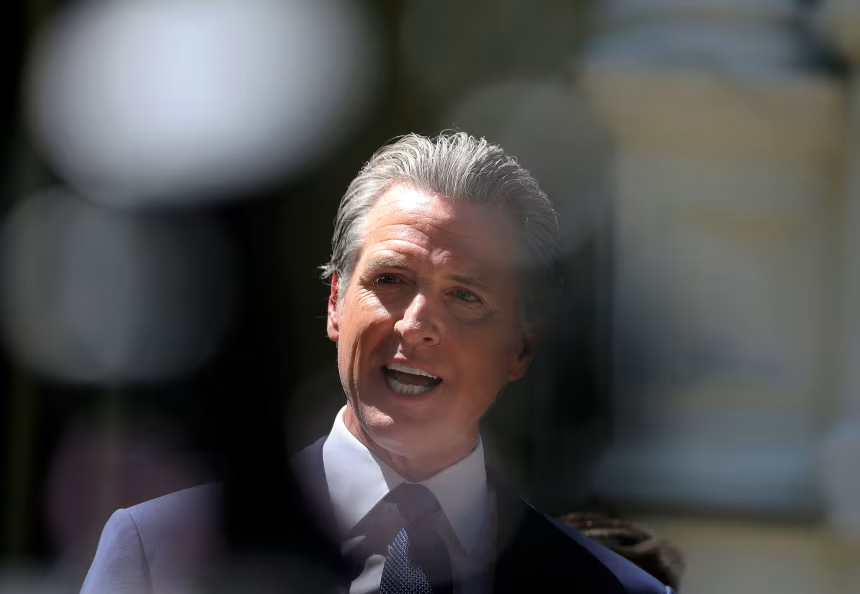
Newsom’s California redistricting push sets up a standoff with Republican-led opposition
Entities mentioned:
- Gavin Newsom: Power, Justice, Determination
- Donald Trump: Power, Control, Competitive spirit
- Greg Abbott: Power, Competitive spirit, Loyalty
- Arnold Schwarzenegger: Justice, Legacy, Righteousness
- Charles Munger Jr.: Justice, Influence, Determination
- Common Cause: Justice, Influence, Wariness
- League of Women Voters: Justice, Unity, Moral outrage
- Steve Hilton: Ambition, Justice, Competitive spirit
- Kevin Kiley: Justice, Self-preservation, Duty
Article Assessment:
Credibility Score: 75/100
Bias Rating: 55/100 (Center)
Sentiment Score: 35/100
Authoritarianism Risk: 45/100 (Mixed/Neutral)
Bias Analysis:
The article presents multiple viewpoints and includes quotes from various stakeholders, indicating an attempt at balance. However, there's slightly more space given to Democratic perspectives and framing of the issue as a response to Republican actions.
Key metric: Electoral Fairness and Representation
As a social scientist, I analyze that this article highlights a significant political conflict over redistricting in California, with potential national implications. Governor Newsom's push to redraw congressional maps is presented as a response to Republican-led efforts in other states, particularly Texas. This creates a tension between maintaining California's independent redistricting commission and strategically countering perceived gerrymandering elsewhere. The involvement of various political figures, advocacy groups, and potential legal challenges underscores the complexity of the issue. The debate touches on core democratic principles such as fair representation and the balance of power between state and federal governments. The potential impact on future elections and party control in Congress makes this a critical issue for electoral fairness and representation across the United States.
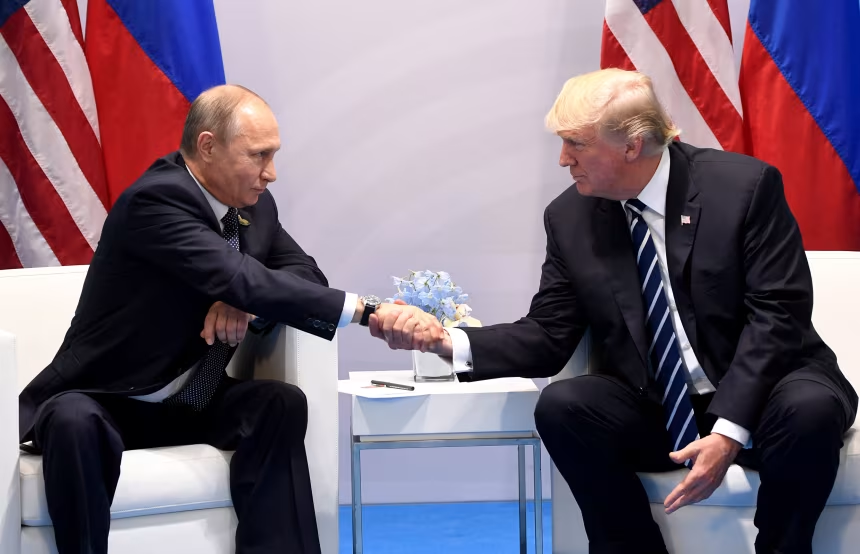
How Trump and Putin’s relationship has evolved since they first met eight years ago
Entities mentioned:
- Donald Trump: Power, Recognition, Influence
- Vladimir Putin: Power, Control, Self-preservation
- United States: Influence, Security, Power
- Russia: Power, Control, Self-preservation
- Ukraine: Self-preservation, Freedom, Security
- White House: Control, Influence, Security
- John Herbst: Professional pride, Duty, Influence
- James Stavridis: Professional pride, Duty, Security
Article Assessment:
Credibility Score: 75/100
Bias Rating: 55/100 (Center)
Sentiment Score: 35/100
Authoritarianism Risk: 45/100 (Mixed/Neutral)
Bias Analysis:
The article presents a relatively balanced view, incorporating various perspectives and historical context. While it includes some critical analysis of Trump's actions, it also presents his viewpoint, maintaining a mostly neutral tone.
Key metric: US-Russia Relations Index
As a social scientist, I analyze that this article highlights the complex and evolving relationship between Donald Trump and Vladimir Putin, as well as the broader US-Russia relations. The article traces the history of their interactions from 2016 to the present, showing how initial optimism has given way to skepticism and tension. The invasion of Ukraine serves as a critical turning point, significantly impacting the US-Russia Relations Index. Trump's changing rhetoric towards Putin, from praise to criticism, reflects the deteriorating diplomatic situation. The article also touches on the lingering effects of the 2016 election interference allegations, which have continually influenced Trump's approach to Russia. This evolving dynamic suggests a potential shift in US foreign policy towards Russia, with implications for global geopolitics and security arrangements.