
Laura Loomer has the White House scrambling again — and she’s far from finished
Entities mentioned:
- Laura Loomer: Influence, Loyalty, Power
- Donald Trump: Power, Loyalty, Control
- White House: Control, Self-preservation, Influence
- Vinay Prasad: Professional pride, Self-preservation, Duty
- Susie Wiles: Control, Duty, Self-preservation
- Robert F. Kennedy Jr.: Ambition, Influence, Power
Article Assessment:
Credibility Score: 70/100
Bias Rating: 55/100 (Center)
Sentiment Score: 30/100
Bias Analysis:
The article presents multiple viewpoints and includes direct quotes from various sources, including Loomer herself. However, there's a slight lean towards portraying Loomer's actions as disruptive, which may indicate a subtle centrist or slight left-of-center perspective.
Key metric: Government Stability and Effectiveness
As a social scientist, I analyze that this article highlights a significant disruption in the normal functioning of government institutions. Laura Loomer's unofficial yet influential role in personnel decisions undermines established vetting processes and introduces instability into key government positions. This can lead to decreased effectiveness of government agencies, potential policy inconsistencies, and a climate of fear among officials. The frequent turnover and loyalty-based appointments, rather than merit-based selections, may result in less qualified individuals in crucial roles, potentially impacting the quality of governance and policy implementation. Furthermore, the external influence on internal government affairs raises questions about the autonomy and integrity of administrative processes, which could erode public trust in government institutions.
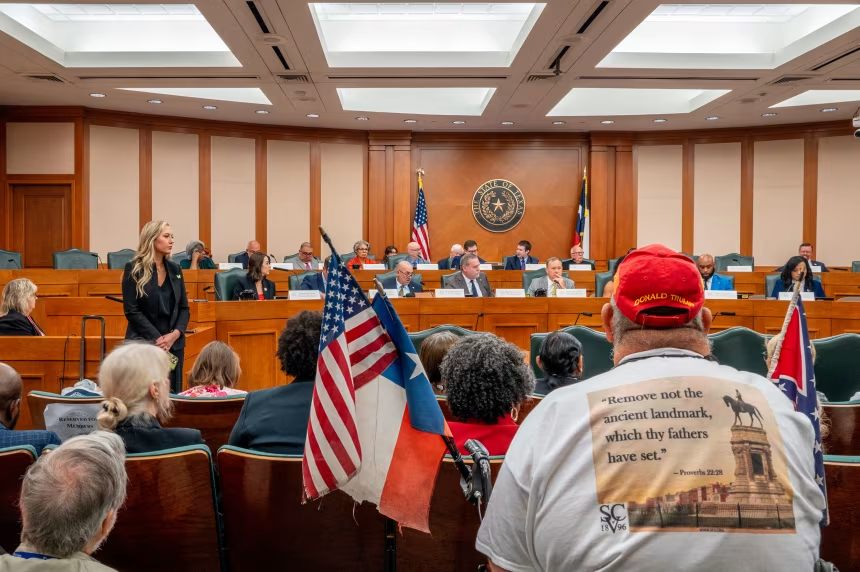
Chief Justice John Roberts enabled Texas’ gambit to gerrymander the state for the GOP
Entities mentioned:
- Chief Justice John Roberts: Power, Control, Professional pride
- US Supreme Court: Power, Control, Influence
- Republican Party: Power, Control, Self-preservation
- Democratic Party: Power, Control, Self-preservation
- Donald Trump: Power, Control, Ambition
- Justice Elena Kagan: Justice, Righteousness, Duty
Article Assessment:
Credibility Score: 75/100
Bias Rating: 35/100 (Lean Left)
Sentiment Score: 30/100
Bias Analysis:
The article leans left in its framing, focusing more on criticisms of the Supreme Court decision and Republican actions. While it mentions Democratic counter-strategies, it portrays Republican efforts more negatively. The source selection and language used suggest a left-leaning perspective.
Key metric: Electoral Integrity
As a social scientist, I analyze that the Supreme Court's 2019 decision in Rucho v. Common Cause has significantly impacted electoral integrity in the United States. By ruling that federal courts cannot review partisan gerrymandering cases, the Court has effectively removed a crucial check on extreme redistricting practices. This has emboldened political parties, particularly Republicans in Texas, to engage in aggressive gerrymandering to entrench their power. The decision has sparked a partisan arms race in redistricting, potentially leading to more polarized and less competitive elections. This undermines the principle of fair representation and could erode public trust in democratic institutions. The long-term consequences may include decreased voter engagement, increased political polarization, and a weakening of the democratic process.