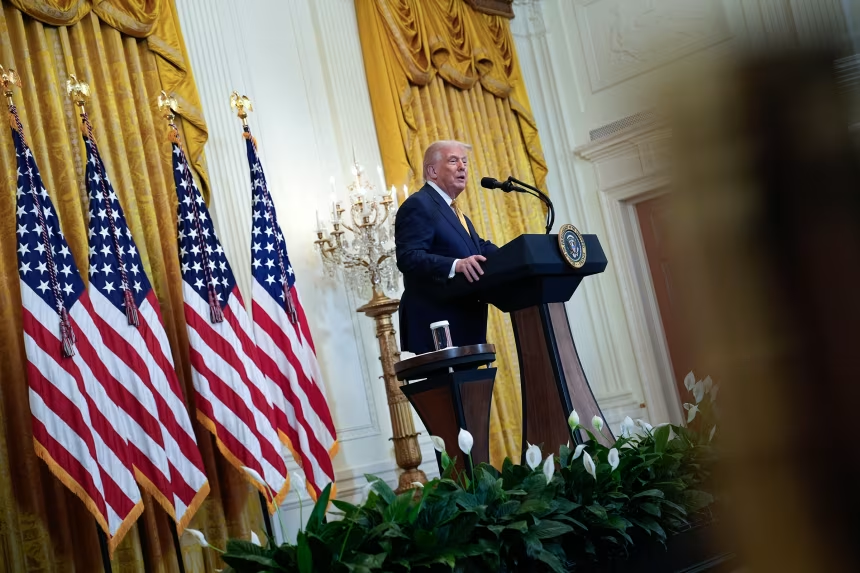
Fact check: Five false claims Trump made about inflation last night
Entities mentioned:
- Donald Trump: Power, Control, Self-preservation
- Democrats: Justice, Righteousness, Moral outrage
- Patrick De Haan: Professional pride, Duty, Righteousness
- Jerome Powell: Duty, Professional pride, Control
- Federal Reserve: Control, Stability, Professional pride
Article Assessment:
Credibility Score: 85/100
Bias Rating: 35/100 (Lean Left)
Sentiment Score: 30/100
Authoritarianism Risk: 20/100 (Strongly Democratic)
Bias Analysis:
The article leans slightly left due to its focus on fact-checking Trump's claims, which are consistently shown to be false. However, it relies heavily on verifiable data and expert sources, maintaining overall objectivity in its presentation of economic facts.
Key metric: Consumer Price Index (CPI)
As a social scientist, I analyze that this article significantly impacts the Consumer Price Index (CPI) metric by highlighting discrepancies between President Trump's claims and actual economic data. The fact-checking reveals that Trump's statements about inflation, gas prices, and grocery costs are largely inaccurate. This misinformation could potentially influence public perception of economic performance and policy effectiveness. The article's thorough debunking of these claims using verified data sources like the CPI, AAA, and GasBuddy emphasizes the importance of accurate economic reporting and its potential effects on consumer behavior and political discourse surrounding inflation and overall economic health.

Republicans want to game the next election. Could Democrats get ‘ruthless’ to respond?
Entities mentioned:
- Republicans: Power, Control, Competitive spirit
- Democrats: Power, Justice, Competitive spirit
- Donald Trump: Power, Control, Ambition
- Ron DeSantis: Ambition, Power, Competitive spirit
- Mike Johnson: Power, Control, Loyalty
- Beto O'Rourke: Ambition, Power, Determination
- Gavin Newsom: Power, Competitive spirit, Ambition
- Hakeem Jeffries: Power, Competitive spirit, Justice
Article Assessment:
Credibility Score: 75/100
Bias Rating: 45/100 (Center)
Sentiment Score: 35/100
Authoritarianism Risk: 65/100 (Authoritarian Tendencies)
Bias Analysis:
The article presents views from both Republican and Democratic perspectives, providing a relatively balanced account. However, there's a slight lean towards criticizing Republican actions more heavily, while presenting Democratic responses as reactive.
Key metric: Electoral Integrity
As a social scientist, I analyze that this article highlights a significant threat to electoral integrity in the United States. The attempts by Republicans to redraw congressional districts mid-decade, and the potential Democratic response, could severely undermine the fairness and representativeness of the electoral system. This practice of partisan gerrymandering, if implemented, would likely lead to increased political polarization, reduced competitiveness in elections, and a disconnect between the popular vote and seat allocation. The potential abandonment of nonpartisan redistricting commissions in Democratic-controlled states like California could further erode public trust in the electoral process. This situation reflects a dangerous escalation in partisan tactics that prioritize short-term political gain over long-term democratic stability. The article also underscores the importance of nationwide standards for redistricting to ensure fair representation and maintain the integrity of the electoral system.
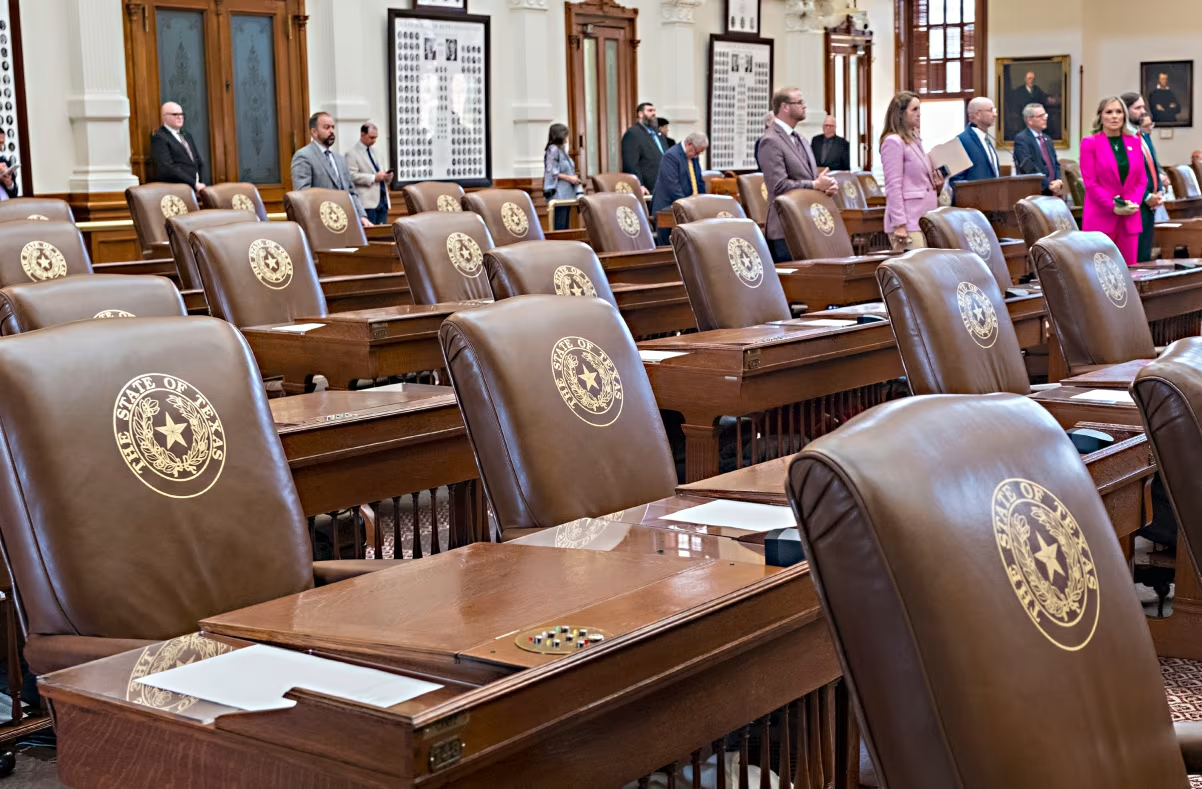
What is gerrymandering? Why is it legal?
Entities mentioned:
- Republicans: Power, Control, Self-preservation
- Democrats: Power, Justice, Competitive spirit
- Supreme Court: Influence, Legacy, Control
- Texas Legislature: Power, Control, Loyalty
- President Trump: Power, Control, Self-preservation
- Gov. Greg Abbott: Loyalty, Power, Control
Article Assessment:
Credibility Score: 75/100
Bias Rating: 45/100 (Center)
Sentiment Score: 35/100
Authoritarianism Risk: 65/100 (Authoritarian Tendencies)
Bias Analysis:
The article presents a balanced view of the redistricting issue, discussing actions and motivations of both Republicans and Democrats. While it critiques Republican efforts more heavily, it also acknowledges Democratic gerrymandering and provides context for the historical and legal aspects of the issue.
Key metric: Electoral Competitiveness
As a social scientist, I analyze that this article highlights the ongoing battle over redistricting and its impact on electoral competitiveness in the United States. The practice of gerrymandering, while historically used by both major parties, is currently being leveraged more aggressively by Republicans, particularly in Texas. This mid-decade redistricting effort, prompted by the Trump administration, could significantly alter the balance of power in the House of Representatives. The article underscores how recent Supreme Court decisions have emboldened partisan gerrymandering efforts, potentially leading to a redistricting war across multiple states. This situation poses a substantial threat to fair representation and the principle of voters choosing their representatives rather than the reverse. The analysis also points out the limitations faced by Democrats in counteracting these efforts due to their own commitments to nonpartisan redistricting processes in some states they control. Overall, this development could lead to a decrease in electoral competitiveness, with more safe seats for the party controlling the redistricting process, potentially undermining the responsiveness of the electoral system to shifts in public opinion.
- Read more about What is gerrymandering? Why is it legal?
- Log in to post comments